segunda-feira, 7 de novembro de 2022

Santos Dumont and Apple at 114 Champs-Élysées, home to the world's greatest innovations


Santos=Dumont's office in his apartment on the Champs-Élysées rendered from photos of the time, superimposed on current ones

It was at number 114 on the Champs-Élysées that Santos=Dumont invented the greatest number of aerial machines - innovation continues at this address with the Apple store (a full plate for those who credit him as a creative egregore).

Much can be said when analyzing the photos of Santos=Dumont's apartment at the time.

Dining Room in the Sky circa 2020 - Apple store


Santos=Dumont's life could have been better documented, were it not for the episode in which Santos sets fire to several documents, in the backyard of his house in Benérville, in August 1914, when gendarmerrie agents suspected that he might be a spy of war (learn more)

Luiz Pagano at Avenida Champs Elysées, 114, on the corner of Rue Washington, Santos Dumont's address in Paris

You that are reading this article may have already noticed that much of the information we see in biographies seems to be repeated from book to book, with a lot of data about some events and, on the other hand, huge gaps, of up to decades, with lost events.


Description of the environments at the time when Santos=Dumont lived in the apartment, we can see the "roundabout" oval room, the office next to the facades of Rue Washington and Champs Élysees and, in the background, the staff and guest room, kitchen and bathrooms.

One can compensate for some of these losses simply by analyzing the various photographs, especially those taken in his apartment on Rue Washington.

In the photos of the time, we see basically four environments:

1 - Rotunda or Oval Room: This is a central and prominent space in the apartment. The oval shape provides a sense of fluidity and elegance to the environment. Possibly the oval hall was used to receive guests and hold meetings. With its unique shape, it sings with sophisticated furniture carefully to suit the room's aesthetic and purpose;

2- The Office of Santos=Dumont, photo overlooking the shelf, detail for the large amount of paper on the table, among them journalistic articles, flight photos, envelope cutting templates and models of nacelles for his airships, etc.

Santos=Dumont's office front photo - S=D evaluates a metal piece, details to be observed: wallpaper with an owl motif, the radica table, lamp and art nouveau frame

S=D analyzing a project in the office next to a model, moments before going to engineering.

2 - Office: In the office, Santos=Dumont dedicated most of his time to reflection and planning. The bookcase suggests that this was a space where he studied and did research. It may have contained books on aviation, science and technology, reflecting Santos=Dumont's intellectual and creative interests;

3 - Engineering: The engineering room was a place of action and experimentation. It was where he began to turn his ideas and projects into reality.

Santos=Dumont's third room would be the equivalent of engineering. Place where he designs the technical part of his aircraft, maintains ropes, cables and fuel, spare parts, as well as builds and makes his models.

Gym equipment, including the rowing machine and weights, suggest that he also valued physical health.


The presence of an engine and battery above the fireplace indicates Dumont's continued focus on innovation and technology;

4 - Dining Room in the Heights: This unique space is where Dumont enjoyed his meals, the billiard table adds a touch of entertainment and relaxation to the room;

4 - Dining Room in the Heights, circa 1904

These four environments combined offered Santos=Dumont a versatile environment that reflected his multifaceted interests, his creativity and his quest for innovation both in aviation and in other aspects of his life.

Santos=Dumont's office in his apartment on the Champs-Élysées

On the wall of one of the rooms, there is a picture behind a table, for example, with stars nailed to the frame that showed one of the pyramids of Egypt and a people riding camels.

Santos=Dumont & o enigma da pirâmide de Gizé, no Egito

Who would those be?

To try to solve this charade, I analyze another photo of Santos=Dumont in Egypt, from a trip we know almost nothing about. In it seem to be Santos=Dumont, someone who looks a lot like Henri Deutsch de la Meurthe, Mr Henrique Dumont (except that the dates don't match as he died in 1891) or even the tutor/protector Garcia.

On page 230 of the biography Santos=Dumont e a conquista do ar (Santos=Dumont and the conquest of the air) by Aluizio Napoleão (1941) appears one of the few references to him in North Africa “Santos Dumont was beginning to get tired of life, Paris betrayed him. 

In vain he crossed the Mediterranean, traveled through North Africa and had his portrait in Tunis, dressed as a sheikh, by Albert, Rue Diazira "photographe de Son Altesse, le Bey". In vain he played in car racing, in engine handling. Interviews with journalists were becoming rare. He was undoubtedly "a character en vedette. But he was not "the" character en vedette.

19th century photograph: Egypt circa 1880 - Pyramid of Cheops, Giza, Egypt, 1890 photo by Lekegian studio.

As for the photo of the pyramid in the background, behind Dumont, there was no one known from S=D there, it is a photograph from the 19th century: Egypt around 1880 - Pyramid of Cheops, Giza, Egypt, photo from 1890 by the Lekegian studio.

Whose picture is on the desk?

In 1917, the New York Journal's European correspondent sent a note about Santos=Dumont's engagement to Miss Edna Powers. Edna was an American who lived in Paris with her parents. The text is in the Aerospace Museum of Rio de Janerio.

Aida d'Acosta, Edna Powers or another woman? - According to the newspaper República, it was Edna Power - but in the close-up photo you can read the dedication in English "To Santos = Dumont", something illegible, and the signature, which can be either Edna or Lurline (depending on how you analyze it the graphology of the "E" or "L").

Or it could also be Aida d'Acosta, the first woman to fly a blimp through the French skies (in the world)

But according to S=D, he was already married to his aircraft family.

Edna or Lurline

Who else should have had the photo on Santos=Dumont's desk was the American millionaire Lurline Spreckels, according to biographer Cosme Degenar.

Santos=dumont and Lurline Spreckels

Dumont was engaged to her until her mother forbade the engagement, believing Dumont to be a dowries hunter.

Other photos that belonged to Santos=Dumont with Lurline Spreckels

On December 21, the Republic newspaper, from Saint Louis, in the United States, informs that “the king of the air is going to marry a beautiful Yankee”. it was not Lurline Spreckels, but another American, Edna Power. The article says that Santos=Dumont's fiancée belonged to the American colony in Paris and “lost her heart” for him when she heard him recount the adventures of his escapes. “And he, in his loneliness away from his Brazilian home, lost his heart to her because she was brilliant, understanding and ingratiating.”

On December 21, the Saint Louis newspaper Republic reported that Santos=Dumont was going to marry Edna Power.

Coincidence or not, Santos=Dumont writes two days later, on December 23, 1901, a letter to his Brazilian friend Pedro Guimarães in which he mentions being in a dilemma – loving and selfish, financially speaking. He does not mention Edna Powers by her name, but refers to "darling".

 A short distance away, on a black plinth more than a meter long, was a white marble bust of Victor Hugo, the aeronaut is known to have had great admiration for the poet of the Chansons des rues et des bois. In fact, the two had many affinities: they were dreamers, visionaries and possessed of a fertile and powerful imagination.


In October 1901, the Brazilian colony in France, presented S=D with a replica of the statue of Jean-Antoine Injalbert (1845–1933), "La Renommée" (the fame), replicated by the talented artist Thiebaud, leaning against the mirror.


In this photo we see the large windows with balconies overlooking the Champs-Élysées, one of which has a well-known photo in which S=D explains the operation of the balloon with guide rope to his brother-in-law, Mr. Carlos de andrade Villares, married to Gabriela.

The Various Environments of the Noble Address

On the corner of Champs-Élysées and Rue Washington lived Santos=Dumont, who made the feat of parking the Dirigeable #9 to have a coffee, Luiz Pagano had dinner with fans of this blog at Le Mood in 2014 and is currently the Apple Store in Paris

The noble address on the corner of Champs-Élysées and Rue Washington, has already had several opportunities to be visited, whether by the 2010 ballad 'Le Mood'.

These are the various tenants of the famous property, Le Mood from 1913, the Apple store and in the days of Dumont

But nothing makes more sense than Santos=Dumont's great expression of genius in giving way to the also innovative Apple store.

For those who believe in creative egregore, perhaps this is the most iconic place in the world! - It was on this table that in 1910 Santos Dumont created his wonderful inventions of air navigation, taking great steps to bring flight to humanity, opening up perspectives of integration and entertainment never seen before. In 2018, Steve Jobs' Apple brings the coolest and most fun innovations the world has ever seen to the same place. There's no denying that big innovations seem to haunt the iconic apartment 114 Champs-Élysées

Elegance that comes in generations - the Apple Watch is inspired by Cartier Santos

Perhaps the choice of Santos=Dumont's apartment in Paris to be the location of the Apple store was not coincidental, Johnny Ive, Apple's head of design, said that when details of the Apple Watch development process were emerging, Marc Newson, who had recently joined Ive's team at Apple, was greatly inspired by the vintage Cartier Santos wristwatch. 

Apple Watch inspired by Cartier Santos

Like the Apple Watch, the IkePod also adopted Cartier's classic square dial Santos, Ive also revealed that the Apple Watch was positioned as a premium smartwatch that would compete with a Rolex, Cartier or Omega.

The Apple Watch uses extremely premium materials, similar to Rolex watches, but has been positioned at a lower price point than these high-end luxury items.

Ive, like Santos=Dumont is a car enthusiast, owned a Bentley Mulsanne and an Aston Martin DB4.

Watches
João Villares, great-nephew of Santos Dumont, holds a watch that belonged to his relative Alberto Santos=Dumont. An interesting curiosity is that João keeps on the dial 16:45, the time when the aviator took off on November 12, 1906, at Campo de Bagatelle, in Paris - picture Rubens Cavallari

Room 4 - Engineering

Santos=Dumont's fourth room would be the equivalent of engineering. Place where he designs the technical part of his aircraft, maintains ropes, cables and fuel, spare parts, as well as builds and makes his models.

Sources and Bibliographies

- GRAHAL, Étude historique et documentaire, 2015.
- Pascal Payen-Appenzeller et Brice Payen, Champs-Élysées: Dictionnaire historique, architectural et culturel, Paris, Ledico éditions, 2013.

The plenary session of the Old Paris Commission met on June 24, 2016 at the Hôtel de Ville under the chairmanship of Mr. Bernard Gaudillère, Councilor of Paris.
The resolutions taken by the Commission were published in BMO No. 58 of July 22, 2016.

terça-feira, 10 de maio de 2022

Santos Dumont and his wearable aircrafts


 When observing birds, Santos=Dumont developed systems of controls that involve his entire body, in which, instinctively, he can, in coordinated and reflexive acts, dominate the dynamics of flight – in that sense, we may say that “Santos=Dumont created wearable aircrafts”, paraphrasing Professor Miguel Nicolelis' grandmother Lygia - his handlings were body centric, all controls were mere extensions of Santos=Dumont's body.


In other articles on this blog I described how Santos=Dumont was not only the father of aviation but also the father of biomimetics and the Wiki philosophy, in this article I tell how he may well have been the father of ergonomics, since it is the scientific study of the relationship between man and machine, aiming at safety and efficiency, as well as bionics, as it is the technique of applying knowledge of biology in the solution of engineering and design problems.

Santos=Dumont, sewed a wooden "T" device in his jacket from which thin rings connected to the control cables that acted on the "ailerons". Tilting his shoulder to the right, he could command the left aileron, and vice versa, reacting both surfaces, in a coordinated manner, according to the inclination of the aviator's body.

As different bird species adapted over millions of years through evolution to specific environments, prey, predators and other needs, they developed specializations in their wings and tails in order to acquire different forms of flight.

By observing the flight of birds, one of the most complex forms of locomotion in the animal kingdom, Santos=Dumont created intuitive ways to make the necessary movements, including taking off and landing, tasks that involve many complex movements.

Controls attached to the 14-Bis jacket

Santos=Dumont, still not knowing a good part of how to control a heavier-than-air aircraft, made his first flight with the 14-Bis on September 7,  around 5 pm: It reached a height of about 2 m and realized that it should place ailerons in the outer cells of the wing, to control the rotational movements.

The only problem is that all his limbs were occupied with other controls, it was then that he decided to put a piece of wood sewn to the back of his jacket and started to control the screw movement by tilting his body to the left or to the right, as we see in Santos Dumont Book - Helio Paes de Barros – 1973 Ed. Federal University of Pernambuco.


“...Therefore, SANTOS DUMONT had solved the problem of flight in a heavier-than-air device: the "14-Bis... As he had both hands occupied in the various controls of the plane, Santos=Dumont, sewed a wooden "T" device in his jacket from which thin rings connected to the control cables that acted on the "ailerons". Tilting his shoulder to the right, he could command the left aileron, and vice versa, reacting both surfaces, in a coordinated manner, according to the inclination of the aviator's body.

Santos=Dumont had the objective of flying like Icarus, individually, and he evolved the wicker basket in order to fulfill this dream – he did it several times to perfection, mainly with the Balladeuse N.9.

Nowadays it is not uncommon to see such adaptations as expensive American military helmets. One example is the helmet or head-mounted display (HMD) developed by Rockwell Collins Enhanced Vision Systems, a joint venture between Rockwell Collins and Elbit Systems, which costs $400,000, a price that is significantly higher than that of a Ferrari.

* Article published on the G1 News Portal on November 04, 2006 - The man who dressed himself as an airplane, giving wings to the mind

October has arrived and with it the chance to once again celebrate two of the most important achievements in the history of Brazilian science.

In fact, I would say more.

If we could choose a single month that represented the daring and creativity of Brazilian national science, it wouldn't be for anyone. October won by rout!

All because this month we celebrate two of the most famous feats of Alberto Santos-Dumont, the greatest of all our scientists. The one that amazed the French people live, with the precision of his daily flights through the skies of Paris, and fascinated the whole world with the realization of humanity's collective dream of flying.

On the afternoon of dubious weather and treacherous winds on October 19, 1901, Santos-Dumont took off from the Saint-Cloud countryside towards the most imposing symbol of French modernism at the time: the Eiffel Tower. After circling it with elegant and precise maneuvers, Santos-Dumont returned to the take-off point to the delirious applause of the crowd that took to the streets of Paris.

The first great aeronaut demonstrated to anyone who wanted to see that the mixture of daring, tenacity and passion makes us fly.

Literally.

And that is precisely what Santos-Dumont did.

He promised he would fly and he did.

Like no one had ever done.

In just over 30 minutes, there he was. Momentarily back on the ground, a hostile environment for this birdman, he listened to the crowd demanding that he be awarded the first grand prize in aviation: the Deutsch de La Meurthe Prize.

But it was not easy to make history. It never is.

Due to a controversy regarding the precise moment of the race's conclusion, Santos-Dumont and the Parisians had to wait until the beginning of November to celebrate the official decision of the Air Club of France.

And how Paris celebrated! As promised, Santos-Dumont divided the 100,000 francs (plus interest) earned from the prize, half among his mechanics and the rest among 3,950 poor people in Paris.
Five years later, on October 23, 1906, Santos-Dumont once again amazed Parisians by flying 60 meters aboard his legendary 14bis plane.

When I was a boy, and the 23rd of October arrived, the greatest neuroscientist I've ever met, my dear grandmother Lygia, always said to me:

“Today we celebrate the day when man dressed up as an airplane.”

Lygia said this because she knew that, since his first airships, Santos-Dumont had created a complex and efficient system of ropes, pulleys and levers that allowed him to feel and control, as no one had done before, all the main components of each one. of your aircraft. There were so many control instruments that many who inspected these aircraft thought it was impossible for a single man to handle them.

One hundred Octobers later, neuroscience may be able to explain this phenomenon.

Today we know that through a process called neural plasticity (or neuronal, for good measure), multiple areas of the brain that contain complete representations of our body continually change these representations (or maps) throughout our lives. Such alterations occur due to changes that can be commonplace (changes in weight) or more dramatic and rare (amputation of a limb) in the spatial configuration of the body. Most of the time, however, these brain maps change due to constant practice of specialized motor tasks, or as a result of changing habits of tactile exploration of the environment. For example, throughout their lives, pianists and violinists develop brain representations of their fingers that are much larger and more elaborate than most of the population.

Recent results suggest that these brain representations of the body also undergo changes correlated with the type of tool used on a daily basis. For example, due to constant practice, professional tennis players are likely to incorporate their rackets as simple extensions of the brain representations of their arms and hands.

In other words, creation becomes part of the creator.

According to this theory, the more efficient the incorporation of the tool by the brain, the better the dexterity and precision with which the operator would use it.

Thus, it is plausible to postulate that, throughout his aviator career, with the practice of constant flights, Santos-Dumont's brain probably developed the ability to incorporate all the components of his aircraft; stabilizers, wings, tires, as if they were nothing more than part of your own body.

From left to right Professor Ricardo Magalhaães, the great-grandnephew of S=D, Professor Miguel Nicolelis. creator of the exoskeleton that allows Juliano Pinto (sitting) to walk after spinal cord injury and Luiz Pagano, writer of this blog. Both professor Nicolelis and patient Juliano sign the handkerchief that belonged to Santos=Dumont - this handkerchief, whichsymbolizes the milestones of Brazilian technological achievements, it already has the signature of Marcos Pontes, the 1st Brazilian astronaut who took it into space aboard the ISS, along with an S=D hat, and the illustration of the 'ALADO HEART OF SANTOS=DUMONT' ' by Romero Brito, an artist who well represents Brazil abroad.


In this way, through brain plasticity, when climbing on his pegasi made of Japanese silk and piano strings, the slender fellow countryman suddenly became a pioneering giant.
Humanity aeronaut.

Brazilian scientist.

Airplane body.

Brain with wings.

Dona Lygia, who would have thought, was once again right.

Unmissable readings for this more than historic October:

"O que eu vi, o que nós veremos." Alberto Santos-Dumont (French. Ce que j’ai vu, ce que nous verrons) Published by Hedra, São Paulo, 2002.
"Santos-Dumont and the invention of flight". Henrique Lins de Barros. Jorge Zahar Editor, Rio de Janeiro, 2003.
"Wings of Madness". Paul Hoffman. Editora Objetiva, Rio de Janeiro, 2004.
 
Miguel Nicolelis, for the G1.


segunda-feira, 17 de janeiro de 2022

Santos Dumont according to Nature invented the plane, not the Wright's brothers – Final Part & Conclusion


After the previous article, in which we see that Santos=Dumont made his flights accompanied by the scientific community, tested and questioned to exhaustion, while the Wrights, supposedly flew away from the public eye. As we saw in the other article that several pioneers relied on weak testimonies in beautiful stories, which seem more like legend than science, such as of the Shivkar Bapuji Talpade and Wright’s, who seem to have been chosen the first to fly as a mere matter of 'American national agenda', we will see in this last and conclusive article the definitive 'birth certificate of the flight', reported by none other than the journal Nature - since always, the most respected magazine in the scientific world.


Read and follow what happened in 1906, when Santos=Dumont was in the spotlight of the human-flight vanguard, in its most diverse forms, while no one had ever heard of the Wright Brothers.

The First “Manned” Flying Machine - Issue Date
08 November 1906


THE FIRST “MANNED" FLYING MACHINE. 

OCTOBER 23 of the present year will be remembered as a red-letter day in the history of flying machines, for it was on that day that the first flying machine, constructed on the “heavier than air” principle, successfully raised itself and its driver from the ground several feet, and transported itself by means of its own power over a distance of eighty yards.

In this his first successful flight with this machine, M. Santos Dumont is to be sincerely congratulated, for he has accomplished a performance which many workers in different parts of the world have been striving after for many years past and failed.  M. Santos Dumont's machine is built on the aëroplane principle, and mounted on two wheels. It is fitted with an eight-cylinder, 60 h.p. motor weighing about 170 lb., and drives an aluminium fan, which makes 1000 to 1500 revolutions a minute. The motor is the work of the Adams Manufacturing Company, England.  With its driver the machine weighs about 750 lb. 

The aëroplane is shaped like a large T placed horizontally. The short arms of the T are slightly inclined upwards, and are each composed of three compartments, like three box-kites tied together side by side. At the base of the T is a large compartment, also like a box-kite, and by manipulating about a horizontal axis the upper and lower surfaces act as a powerful rudder. This rudder arrangement is at the front end of the aëroplane, and the operator stands on a platform midway between, and nearly on a level with, the lower surfaces of the two main inclined arms. The driven fan is situated at the rear of the machine, just behind the operator, at the junction of the two main inclined arms. 

Now that success has rewarded this daring investigator, it is of interest to take a cursory glance at the steps which ultimately led the way to success. 

One naturally, in the first instance, calls to mind the very interesting experiments carried out in 1893 by Herr Otto Lilienthal near Berlin (NATURE, vol. xlix., p. 157), because Santos Dumont's aëroplane is, generally speaking, somewhat after the style of the gliding machines used by him. Lilienthal's experiments were confined to trying to learn soaring, and he employed slightly curved wings having a surface of about 15 square metres. With this inclined planes, and eventually vertical and horizontal rudders, he started from the top of a hill, and after a few steps forward jumped into the air and glided sometimes 250 metres. Lilienthal depended for the success of his apparatus on himself, trusting to his instinct to be able to keep his balance by making the necessary compensating adjustments by moving his own centre of gravity. In later experiments he employed some mechanical aid to assist him in sustaining himself longer in the air. This consisted of a small machine driven by compressed carbonic acid gas, and operating a series of feather-like sails which were capable of flapping. He found that occasional flapping of these wings helped him to cover longer distances. 

In 1895 he adopted a new principle, and instead of using one large framework, employed two smaller ones, placed parallel one above the other; this method he found distinctly advantageous (NATURE, Vol. lii., p. 300). 

About this time Lilienthal's soaring experiments began to be taken up both in this country and in America. Mr. Percy 'S. Pilecher in England gained considerable experience both in the making and in the handling of these aëroplanes (NATURE, vol. Ivi., p. 344). Unfortunately, as in the case of Herr Lilienthal, an accident during his experiments re sulted in his death. Pilcher, however, was quite aware of the importance of using some motive power, and some time before his death proposed to employ, and actually began to make, a small and light engine, indicating about 4 h.p., to drive a fan, this being considered by him as more than sufficient for flights of moderate length. With this advance it was hoped that much greater distances could be covered, and a nearer approximation to a flying machine attained. 

There is little doubt that if Pilcher had been spared he would soon have constructed and made use of the latest and lightest form of motor, and probably been led to use the double-decked form of aeroplane adopted by Santos Dumont. 

By embodying the best ideas of his predecessors and using his own ingenuity to make the aëroplane a practical flying machine, Santos Dumont has advanced the science of aëronautics a very considerable step. The petrol motor has no doubt helped greatly in facilitating this progress, since high-powered engines of comparatively very light weight can be constructed.

In this pioneer work of navigating the air the work of Hiram Maxim and S. P. Langley must not be forgotten. Maxim made numerous attempts to drive his flying machine at such a speed that it would be lifted off the rails on which it ran, but on fully accomplished. Further, it was not known whether it would capsize or not if it was set free. Langley, on the other hand, was undoubtedly the first to demonstrate that a machine heavier than air could be made to travel in the air driven by its own all "unmanned," but nevertheless much valuable in- formation was accumulated. 

This the last achievement of Santos Dumont will no doubt give a fresh impetus to the problem of flight, and those who have the money and time have now before them a successful aëroplane that can serve as a starting point. 

sábado, 13 de novembro de 2021

Santos Dumont or the Wright Brothers, Who Really Invented the Airplane Part 2


The subject of the 'primacy of flight' gained new momentum in Brazil after the controversial statement made by the respected aircraft scholar, Lito, from Aviões e Músicas at his Channel on Youtube, who believes in the version that the Wright Brothers were the first to fly, while one of pioneers in civil space flight and Virgin Galactic's credentialed space agent, Marcos Palhares vehemently disagrees. If you did no read the first part of this article, please click here.


After an exhaustive documentary research, which included reading several newspapers of the time, written in several languages, including all editions of L'Aérophile, a French magazine specialized in the subject of the time, from 1902 to 1910, as well as a CD-ROM with all the clipping from the Wright brothers, painstaking work never before done on the subject. Palhares definitively exposes the facts, and shows us in a documentary way that Santos=Dumont was, without a shadow of a doubt, the inventor of heavier-than-air (watch the LIVE in Portuguese).

The Wright brothers' first effectively public flight took place only on August 8, 1908, in which they were duly accompanied by a scientific committee, documented by photos and filmed in the presence of the general public. Prior to that, all other alleged flights had no proper documentation, were merely based on out-of-context allegations and photos, not different from flights performed by pioneers prior to Dumont.

Here I make an overview of the argument that Marcos Palhares, defending pimazia by Santos=Dumont, presented in a live made on November 12th, in celebration of the 115th anniversary of the first flight of 14-Bis, beside me, Luiz Pagano writer of this blog and of Henrique Lins de Barros, greatest specialist and biographer of Santos=Dumont.

It all started when Palhares visited The National Air and Space Museum in Washington, DC, he was looking for something about Santos=Dumont, and was enormously frustrated to find only a small model and with sayings that disparaged the Santos=Dumont flight compared to the Wright brothers . The institution had a strong connection with Santos=Dumont in the past, in part due to the friendship of Dumont and Samuel Pierpont Langley, another great pioneer of American aviation and third secretary of the Smithsonian, occupying the position from 1887 to 1906.

Live commemorating 115 years of the 14-Bis flight - Luiz Pagano, Marcos Palhares and Henrique Lins de Barros

We know that airship #9 belongs to the museum, among other marvels made by the aviator – why then are they not exposed?

The truth is that there was in the United States the so-called 'Patent War', started by the Wright brothers, in which the magistrate ends up benefiting the secret and implausible Wright flights, reducing the importance of other really important American pioneers, like Langley himself, and the incredible Glenn Curtiss, completely ignoring events in France and the rest of the world.

These were flights defended by judges of law and not by scientists.

Who Was Glenn Curtis

To understand why it's important to 'some' Americans that the Santos=Dumont story be obliterated, it's important to know who Glenn Curtis was.

Glenn Hammond Curtiss (May 21, 1878 – July 23, 1930) was perhaps the most important pioneer of American aviation and founder of the US aircraft industry. He began his career as a rider and bicycle builder before moving into motorcycle racing, in 1904 he began manufacturing airship engines and in 1908 Curtiss joined the Aerial Experiment Association, a pioneering research group founded by Alexander Graham Bell in Beinn Bhreagh, Nova Scotia, to build aircraft.

Curtiss worked in daylight, created the Curtiss Airplane and Motor Company. His company built aircraft for the US Army and Navy, and during the years leading up to World War I, his seaplane experiments led to advances in naval aviation.

The Wright brothers, for their part, who claimed to have made the self-propelled flight on December 17, 1903, never had an engine (which makes such a flight an absolute impossibility). A patent applied for by the brothers called U.S. Patent 821,393, granted on May 22, 1906, shows a glider, not different from the one the Ukita Kōkichi used to jump off the Ashigawa River Bridge 118 years earlier (see the first part of this article).

Inexplicable gaps

Since the alleged 1903 flight, as well as the Wrights' own plane called the 'Flyer', everything was hidden from the public and the attempted flights only appear in the form of newspaper notes, never with photos, while their fellow countrymen Curtiss and Langley tried their flights in a scientific way, sharing and publishing their results in extensive reports with diagrams and photos, in magazines respected by the medium such as Scientific American and Nature.

That's when the 1904 Universal Exposition, also called the St. Louis World's Fair, was born, a world fair that took place from April 30th to December 1st, 1904, in conjunction with the Olympic Games, an ideal moment for the Wrights to show his invention since the organizing committee would even give prizes to whoever flew at the event – but they didn't go to the Fair.


Hamburgers, soft drinks and Hot Dogs were popularized at this fair, which had enormous cultural importance for American history, which was attended by Langley, Thomas Baldwin and William Avery.

Santos=Dumont went but had his airship #7 cut by a knife, possibly in an act of sabotage, on June 26, 1904, and the long-awaited presentation he would make, enormously anticipated by the American public, who by now loved Dumont , cannot see his flight (see https://santosdumontvida.blogspot.com/2012/02/como-santosdumont-fara-seu-voo-sobre.html )

What then explains the fact that the Wright brothers didn't show their plane at the event? Wouldn't a flying demo help them sell their airplane? Could it be that they weren't interested in the prize?

In 1905 the brothers claim to have flown for 38 minutes, and no one knew which engine they would have done it with, but in the 1908 public demonstration, in which the plane was catapulted into the air, they could not stay in the air for more than 2 minutes per launch, losing altitude with each flight until landing.

At the same time, in addition to the first documented flight in history on November 12, 1906 made by the 14-Bis, Farman won the third Archdeacon award using an Antoinette engine, for performing the first circular flight, Louis Bleriot and Joseph Lagrange who also used a Antoinettes also flew and remained in the air longer than the Wrights.

So why then did public opinion decide to accept the Wright brothers as the first to fly at the expense of all the others who were far more successful and scientific?

The answer to that question is simple! The Wrights filed patent applications, paid lawyers to redeem their rights against anyone who claimed to diminish or equal their deeds, it was said at the time that no one could wave their arms, imitating the flapping of their wings, as they ran the risk of being sued by the Wright.

Even so, the Smithsonian maintained as an aviation pioneer, believe it or not, Samuel Langley, who even without having had absolute success with his 1903 flight, received the title of 'Father of American Aviation', and then in 1914, Gleen Curtis successfully reproduced the Aerodome flight with modifications made in order to fly. This title lasted until the year 1948 – until that point in american history, the Wrights brothers did not have the scientific recognition of the Smithsonian Institute.

Another important point to note here is that, while the Wrights defended their meager feats with animalistic aggression, Domont, as always, elegantly wrote in his book O Que Eu Vi O Que Nós Veremos, Santos=Duomnt 1918:


“The following year the Farman airplane made flights that became famous; it was this inventor-aviator who first got a round-trip flight. After him came Bleriot, and only two years later did the Wright brothers make their flights. It is true that they claim to have made others, but in secret.

I don't want to disparage the achievements of the Wright brothers, for whom I have the greatest admiration; but it is undeniable that, only after us, they presented themselves with a device superior to ours, saying that it was a copy of one they had built before ours. Right after the Wright brothers, Levavassor appears with the airplane "Antoinette", superior to anything that existed then; Levavassor had been working on solving the flight problem for 20 years; he could therefore say that his apparatus was a copy of one built many years before. But he didn't.

What would Edison, Graham Bell or Marconi say if, after they presented the electric lamp, the telephone and the cordless telegraph in public, another inventor presented himself with a better electric lamp, telephone or wireless telephone apparatus saying that he had them built before them?!
To whom does humanity owe air navigation for the heavier than air?

To the Wright brothers' experiments, made on the sly (they are the ones to say that they did everything possible so that none of the results of their experiments transpired) and which were so ignored in the world, that we see everyone qualifying mine as "memorable minute in the history of aviation," or is it the Farmans, Bleriot and me that we did all our demonstrations in front of scientific committees and in full sunlight?"

General considerations

Anyone who sees Palhares' exposition of facts gets immediately convinced that Dumont was without a doubt the inventor of heavier-than-air.

Why then do we let the world believe it was the Wrights?

The answer to this question may generate revolt in some of us Brazilians, as it is closely linked with the self-inflicted "stray mutt complex" that some Brazilians voluntarily submit themselves to when compared to the rest of the world, with self-sabotage and limitless destructiveness power, which greatly delays our development and seems to cause a kind of collective schizophrenia, as well as a setback karma, very difficult to be redeemed in several generations.

It's very important for us, Brazilians, to take this scolding and start to change, because right now there are Brazilians, as or even more remarkable than Santos=Dumont, working on ingenious discoveries, aimed at the good of humanity, which deserves our full support (eg Professor Nicolelis, Ester Caldeira Sabino, Jaqueline Goes, etc.).

At this very moment, I'm doing a research and developing a production process for 'Cauim', with the objective of bringing this ancestral alcoholic beverage from South America to be consumed by the general public through modern production processes, (traditional indigenous beverage made out of fermented manioca, Brazilian kind of casava), with socio-cultural purposes of great value to Brazil. 

Over the last 10 years, I have encountered all kinds of barriers to advancing the project, mainly on the part of inspection departments, without the slightest incentive to technological development, having to pay for research, experiments and travel out of my pocket, having to deal with the enormous bureaucracy, which has already delayed the launch by more than 5 years, with no prospect of a date for the creation of a new category by the Ministry of Agriculture, Livestock and Supply (MAPA), It is a drink widely known by Brazilians, perhaps even more popular than chachaça, certainly more Brazilian than cachaça, which predates the arrival of settlers in the Americas.

Why is this beverage still not available to the general public?

Cauim has the potential, for ethnic groups that decide to join the project, of promoting their culture in a sustainable way, maintaining and even expanding the areas of standing forest, generating a return of socio-economic resources in a way that is unprecedented in our history.

Another experience I had with our people's disregard for our own legacy and culture, as well as the issue of museum management and our cultural heritage, happened when I was 15~16 years old, when I worked with Mrs. Ada Rogato, brazilian pioneer of aviation that in 1951, made the famous flight across the three Americas, with a Cessna 140.

Luiz Pagano and the Cesna 140 that belonged to Dona Ada Rogato - - "How can this plane survive its owner?! - When I was 16, I met one of the most special women in my life (I apologize to my wife Jane for that), it was Dona Ada Rogato. In 1983, I wanted to work, do something interesting - I started as a volunteer cleaning planes at the old aeronautics museum, in Oca do Ibirapuera, in São Paulo ,Brazil. The two other guys who cleaned planes with me, 'Colina' and 'Odilon', gave the following suggestion: -Go and ask that little lady, a bucket and solvent, to erase the scribbles of this Cessna." I never thought that anyone could curse me more than she... It was the plane that Dona Ada used to circumnavigate the Americas, every place she stopped, the locals signed and posted affectionate messages. Before leaving the museum, we stayed with her to hear one of her various adventures, in which she often had to put her life at risk because of that plane and its signatures."

I volunteered to clean the museum and the aircrafts, and the only payment I got was listening to the amazing stories Mrs. Ada use to tell us, every day at the end of the working hours. She literally carried the museum on her back. After her death, the museum left Oca do Ibirapuera and the collection was spread out in a very irregular way, without us knowing where and how they are kept.

While people from other nations fight for their scientists to shine in the academic world and gather together to inscribe them for the Nobel Prize, we here give little importance to this and keep our hands in our pockets asking “when will a Brazilian receive a Nobel Prize? ”

While in the United States there are landmarks and memorials of the Wrights' achievements in Dayton, Washington and practically all other states, here in Brazil the museum of the oca was closed and its collection was inadvertently spread throughout Brazil. We allowed the Cabangu Museum to be closed due to lack of funds and for the National Museum in Quinta da Boa Vista to go up in flames on the last 2nd of September 2018.


While Tom Crouch, curator of the Sithsonian since 1974, has written two books about the brothers and defends the Wrights' achievements tooth and nail, here we have a leadership of museums that barely know the story of Santos=Dumont.

I was flattered by the invitation, together with Henrique Lins de Barros and Marcos Palhares, rescuing the importance of this Brazilian hero to inspire new generations, on the day commemorating the 115 years of the first flight of Santos=Dumont, it was a beautiful moment in my life. 

This post is a mere summary, reporting my impressions of the LIVE - I strongly suggest that you watch it in full so that you can draw your own conclusions.


quarta-feira, 10 de novembro de 2021

Santos=Dumont or the Wright Brothers, Who Really Invented the Airplane - Part 1


 The issue regarding the 'primacy of flight' - who in fact invented air navigability, and brought us all the benefits of the magnificent invention of devices that allow human flight, is a subject that is debated a lot in Brazil today, but it seems to be a question closed in the United States - it is even considered a taboo.


I avoid this issue whenever I can, especially when there are American friends in the conversation, but this week I was put up against the wall and had to say my opinion about it. I was with João Villares, great-nephew of Santos=Dumont, whose physical resemblance to the inventor always moves me (see photo), some Brazilian air force officers, friends and a group of reporters at the São Paulo Air Force base, who tirelessly searched for answers.

After that, in a meeting with friends 'Dumontologists', Marcos Palhares, Astronaut of Virgin Galactic and Henrique Lins de Barros, greatest and most respected scholar, specialist in Santos=Dumont, (you can watch this LIVE here), I decided to make this post, reluctantly, as I much prefer to show on my blog the 'wonderful life of Santos=Dumont', as the title says, than to keep bringing up issues that allow for the already fierce dispute and divisions that have polluted the pages of social networks lately.

“So, OK” I said, “let's go back to October 23, 1906, at the Campo de Bagateli in Paris...”
Luiz Pagano and João Villares, great-grand-nephew of Santos=Dumont at the São Paulo Air Force base, in the background Tupi Pop paintings by Luiz Pagano, part of the Aeronautics collection, in the Authorities Room at Guarulhos airport

On that day Santos=Dumont has just been recognized as the Archdeacon award holder for having flown 60 meters with an aircraft conceived, designed and piloted by himself. The rules called for the aerial device to take off by its own means, without any kind of outside assistance, have pertinent flight controls, and land without accidents of any kind. S=D did this in front of the judging committee, in the presence of members of the scientific community at the time, photographer reporters and even a cameraman, not to mention the thousands of people present in the park - everyone was celebrating because humanity had just seen the first flight of heavier-than-air....

At that moment, a surly fellow approaches, determined to end up with the party’s atmosphere and shouts to the people "wait, wait ... , someone have already flown in America", some three or four people who hear him in the crowd looked at him shocked, and one of them exclaims "what are you saying?", the spoilsport then promptly goes on:

Spoilsport - This was not the first flight.
Perplexed Interlocutor – What are you saying?
Spoilsport – Two brothers in America already flew, almost three years ago, on a beach in North Carolina.
Perplexed interlocutor - was it registered by the scientific community, did it have witnesses?
Spoilsport – Yes, some civil servants, three passersby, a dog and even the president of the city bank.
Perplexed interlocutor – did the plane take off by its own means?
Spoilsport - No, the takeoff was carried out through a rail that pulled the plane, without the use of wheels, and threw it into the air.
Perplexed Interlocutor – Is this reported anywhere?
Spoilsport – Yes, in their personal diary.
Perplexed Interlocutor – Do they have a patent, or something that proves the flight?
Spoilsport - The Wright Brothers filed for patent even before their first trial flight. The application, which included diagrams of the invention, was sent on March 23, 1903.

-----

This was a hypothetical dialogue, but based on the facts of the time.

In my defense

I must say that I really admire the Wright brothers, I consider their work ingenious, as much as that several other aviation pioneers, I love American culture and I envy the way they treat their heroes in America, I even put a replica of Flyer that I nicely illustrated in a comic story that I wrote for a Brazilian magazine called Superinteressante, Issued in February 2002 (see photo).

I had the enormous privilege of working for two American companies, firstly as desk dealer the former Chemical Bank, company that I worked for almost three years and a stove manufacturer from Los Alamitos CA called Dynmac Cookins Systems, I have always been very well received in the United States and most of all, I love american people, I would like it very much of having in my country, Brazil, a system that privileges scientists, museums, professors and scientific discoveries as much as the USA does.

Illustration by Luiz Pagano for his comic book, with a replica of the Wright Brothers Flyer in the background "I greatly admire and respect the Wright Brothers, as well as the dedication to science of the American people"


Finally, I do not in any way, want to demoralize or reduce the importance of anyone, I simply want to recognize the facts that need to be recognized in the matter of the primacy of flight, in a scientific documental way.

That being said, let's get to the facts:

Why Smithsonian belittles Santos=Dumont?

Marcos Palhares, a Santos=Dumont scholar, visiting the Smithsonian, found that despite having a large collection of pieces from our father of aviation, the Smithsonian's National Air and Space Museum, the institution that maintains the largest and most significant collection of aviation and space artifacts of the world, fully dedicated to the science of aviation, placed Santos=Dumont in a lower corner of its huge space, with a few models, with the following words:


"Brazilian Alberto Santos-Dumont made the first public flight of a powered airplane in Europe with his 14-bis on October 23, 1906, covering 60 meters (197 feet). On November 12, 1906, he traveled 220 meters (722 feet), still short of the Wrights' best flight of 1903".

*** This article is made up of a continuation (Part 2) and its conclusion (Part 3) - please click on the two previous links for a complete overview.

It is quite clear that, unfortunately, the institution omits science in the name of the 'America First' policy and despises the achievements of the Brazilian aeronaut.

This kind of attitude only raises suspicion against the American historical context - when comparing the Wrights with Santos=Dumont in such a diminutive way, it is evident that at some point in history, Dumont's multiple achievements caused discomfort to the fragile and untenable position of primacy of the brothers.

The Wrights' Secret Flight

After the secret flight from Kill Devil Hills, North Carolina, on December 17, 1903, the Wright Brothers - Orville (August 19, 1871 - January 30, 1948) and Wilbur (April 16, 1867 - 30 May 1912) continued work on a cow pasture in Dayton from 1904 and 1905.

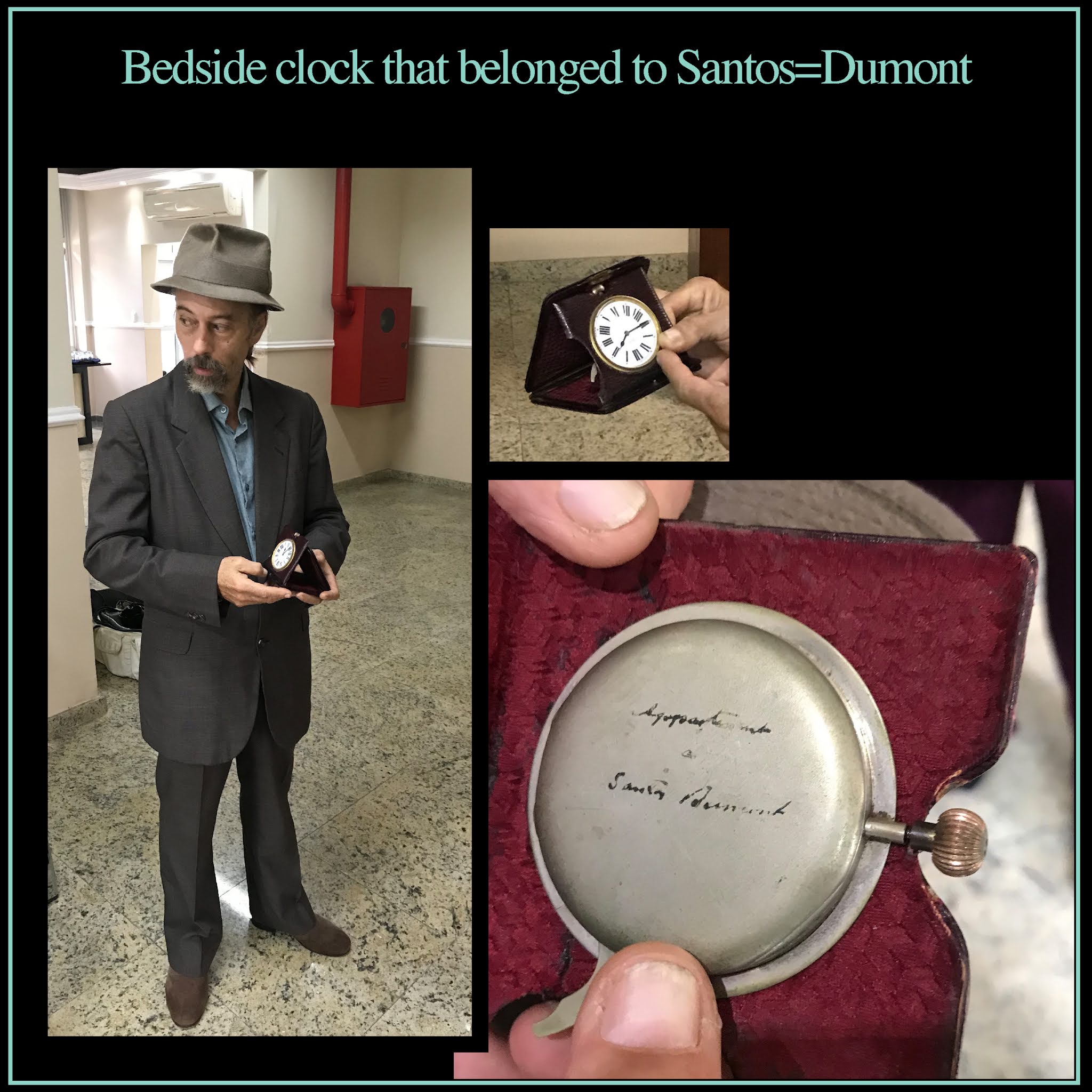
João Villares, great-grand-nephew of Santos=Dumont, shows the bedside clock that Santos=Dumont wore on all his trips. on the back the inscriptions "appartenant à Santos=Dumont" - belongs to Santos=Dumont


The Wrights were terribly concerned about being copied. In no way wanted to reveal their creation without patent protection and a signed sales contract, the brothers remained at the site for the next two and a half years while they tried to commercialize their invention.

So it was that, at dawn in 1908, with plane sales contracts to a French union and the US Army finally in hand, the Wrights were ready to take off again that spring. They returned to Kill Devil Hills with a rebuilt version of their 1905 plane - now modified with upright seats and controls, and a second seat for a passenger. On May 14, 1908, Wilbur and Orville took turns taking Charles Furnas, one of their mechanics, as a passenger.

Weight x power ratio

According to Ozires Silva, co-founder of Embraer, the conglomerate that is the third largest company in its field in the world, the Flyer could never have flown because it violated the laws of physics.

The laws of physics states that it takes 1Hp to lift 6 kg off the ground, the Flyer had almost 23 kg per Hp - impossible flight

According to him, there is a weight/power ratio of the engine, in which planes heavier than air need to overcome gravity through displacement in the atmosphere - 1 Hp sustaining 6 kg of flight is the limit, the greater the weight per HP, the lower the flight probability.

In the case of the 14 bis of Santos=Dumont, we had a 50 Hp engine to sustain an aircraft weighing 290 kg (average 5.8 - within the limit of what is possible). The Flyer, on the other hand, weighed 274.4kg and had a 12Hp engine (average 22.83 - completely out of the possible).

The laws of physics speak for themselves.

The Wright Brothers' Public Flights

It is important to say that the Wright brothers' first effectively public flight took place only on August 8, 1908, in which they were duly accompanied by a scientific committee, documented by photos and filmed in the presence of the general public. Prior to that, all other alleged flights had no proper documentation, were merely based on out-of-context allegations and photos, not different from flights performed by pioneers prior to Dumont.

Flying replicas - No attempt to replicate the Wright brothers' Flyer's flight took off, as did Ken Hyde of the Wright Experience with the American Institute of Aeronautics and Astronautics (AIAA). Meanwhile, replicas of the 14-Bis fly regularly, like this one owned by enthusiast and pilot Alan Calassa, who even wanted to send one of his replicas to the Smithsonian - but unfortunately, the proposal was rejected by the museum.

The Wrights invited the public, and the media to witness their flights in late May of 1904. About 30 reporters showed up at Huffman Prairie on May 23. The Wrights could not get the airplane motor to run properly, and everyone went home disappointed. 

A handful came back on May 26, but the Wrights were only able to manage a glide flight of about 25 feet 

In 1905, after the Wrights felt they had worked the bugs out of their invention and had created a practical airplane, they invited the public back again. They sent out about 30 invitations to people whom they thought would make credible witnesses. Several hundred showed up at Huffman Prairie to watch them fly on October 4 and 5, 1905. On October 5, Wilbur claims to have been able to keep the Wright Flyer 3 in the air for 39 minutes, flying 30 complete circuits of the field and covering over 24 miles -- in public.

In short, the Wrights claim to have made at least six flights of varying degrees of success before 1906.

If only witness claims serve to attest to the first flight, we must disregard Dumont and the Wrights for electing Clement Ader as the great inventor, who claimed to have made a flight with the Éole (aka Avion) before 1900. Ader, just like the Wrights, was flying in secret to the military.

The world only witnessed the Whright brothers' flight in the year 1908, in France, when Wilbur began catapult-powered flight (did not take off by its own means) on August 8, 1908, almost two years after Dumont, on the airstrip of Hunaudières horse racing near the city of Le Mans in France. His first flight lasted just 1 minute and 45 seconds.

Flying Replicas

Besides Dumont and the Wright Brothers, which other pioneers claim the title of first to fly?

- Abbas Ibn Firnas - The first report of a gliding flight took place in the year 875, in Andalusia, a poet of the time said that it flew faster than the Fenix, but it took much longer than the mytical bird to recover from the terrible accident;


Bartolomeu Lourenço de Gusmão (Santos, Brazil,  December 1685 — Toledo, November 18, 1724) was the first Brazilian inventor and scientist, famous for the creation of the hot air balloon in 1709. 


For the design and testing of a scale balloon called Passarola, Bartolomeu Lourenço de Gusmão, nicknamed the flying priest, was considered the father of aerostation. But we must remember that it was the Montgolfier Brothers: Joseph-Michel and Jacques-Étienne, two pioneering French inventor brothers, who built the first manned balloon in the world, which raised Étienne to the skies on June 5, 1783.

- João de Almeida Torto - was a Portuguese resident in Viseu who in 1540 with the aid of a self-designed flying apparatus, on 20 June, having tried to fly with a wing system manufactured by himself. 


It is said that on June 20, 1540, João Torto will have climbed to the top of the Cathedral of Viseu where he had built, with the permission of the Church, a launching ramp.

-Karl Wilhelm Otto Lilienthal (Anklam, Pomerania, May 23, 1848—Berlin, August 10, 1896), known as the "Father of gliding flight"From 1891, Otto began his collection with more than two thousand flight attempts , in some cases performed up to 80 times a day. 


On several of these occasions the German aviator had a sprained foot and broken arms, in what can be considered the first air accidents.

- Ukita Kōkichi (浮田 幸吉, 1757 – 1847) was a Japanese aviation pioneer, ancestor of my friend Yasuyuki Ukita, writer and journalist, great connoisseur of Santos=Dumont, who is often praised for making artificial wings and flying with them. He is considered to be the first Japanese person to fly. He is also known as Chōjin Kōkichi (鳥人 幸吉/Kōkichi the birdman), Hyōgu-shi Kōkichi (表具師 幸吉/Kōkichi the Paperhanger), Sakuraya Kōkichi (櫻屋 幸吉), Bizen'ya Kōkichi (備前屋 幸吉), and Binkōsai (備考斎).


Ukita tried flying from a bridge over Asahigawa-river(旭川) in the summer of 1785. Some references say that he glided several meters, but others say that he just fell.

Several other aviators or their supporters claimed the first manned flight in a powered plane. Claims that have received significant attention are:

-Shivkar Bapuji Talpade with his airplane Marutsakhā (1895) - flew 460m at Chowpatty Beach, Mumbai, Indian pioneer with interests in aeronautics and Sanskrit;


-Clément Ader in 1897 invented and patented an aircraft based on the designs of a pioneer in biomimetics, Louis Pierre Mouillard, called by various names – Éole; Zephyr; Avion, but what the French liked to call the 'énorme chauve-aouris en lin' (the huge linen bat).


It had a redesigned light aluminum steam engine, with 4 cylinders and 20hp of power, the Éole Ader flew 100m at a height of 20cm from the ground in Sartory, south of Versailles;


-Gustave Whitehead, a German immigrant, residing in Connecticut with the model aircraft 21 and 22 (1901-1903) – the number 21, which had its design inspired by Lilienthal's wing, flew for the first time 201 meters in Fairfield;

-Samuel Pierpont Langley (1903) - and his airplane called 'Aerodrome A';


-Karl Jatho (1903) - On August 18, 1903, 4 months before Orville Wright, Karl-Jatho, born in Hanover February 3, 1873 - Hanover,  took off from flat ground with the sole impetus of his engine. 18 meters on his first flight, with a tricraft, three meters above the ground, in November 1903, still a month before Wright, he performed a series of flights over 200 feet and over 10 feet above the ground.


Since we can accept accounts and the testimony of bystanders as evidence, I don't see why we can't accept Shivkar, Ader or even Whithead as having been the first to fly, they all came before Dumont and the Wright Brothers, they're all awesome and genius, and all of them have wonderful flight reports.

All these pioneers mentioned above have their flights reported by witnesses, as valid as the Wright brothers' witnesses, but with the exception of Santos=Dumont, none of them flew in the presence of other scientists, journalists, technical committees, who validated their flights based on scientific methods, with reliable, extensive and secure documentation. Santos=Dumont was the first to have his flights filmed.

---

The brothers Louis and Auguste Lumière projected a film for the first time in 1895, filming and projecting movies was already a reality, from the first flights and it is excellent scientific evidence - why then has never been cinematographically documented any flight of these other pioneers?

If we are going to use the proper and perfect use of the scientific method, taking into account the problem solving approach, where scientists ask pertinent questions and carry out different tests, demonstrate the discovery in front of experts, capable of evaluating all steps on a scientific basis, without prejudice or interests other than science - there is no doubt that Santos=Dumont was the first man to fly with the heavier-than-air, to bring to humanity all the benefits of air transport and to inspire a whole generation of new pioneers.

sábado, 23 de junho de 2018

Santos=Dumont and his Aerial Dinner Parties

Santos=Dumont sitting at his high tables with guests

There are reports that when he lived in Paris, in the early 1910s, Santos=Dumont had tables two meters high made, accompanied by small stairs, so that the guests could climb on the high chairs, as well as, so that the waiters could serve them. He placed these tables in his apartment on the Champs Élysées and hosted some meals for very special guests.

Other reports say that only a table set with four chairs was made.

leia essa matéria em Português

Unfortunately, we do not have many references to how, when, and why Santos=Dumont promoted these "Dinners in the Heights", the few that come to us end up being distorted, incomplete, biased and pejorative.
Reconstitution of the dining room in the heights based on photos from the time.

But I have no doubt that they must have been very extravagant, sophisticated and therefore unforgettable events.


Santos=Dumont's appreciation of experiencing unique meals, and living a life-style worthy of what he use to read in the adventures of Jules Verne, came to be known later when he frequently stopped his dirigible#9 in the restaurant 'La Grande Cascade' , or in front of his elegant apartment in Paris, just to have a coffee with friends, and return to his flights.

But it was with the Aereial Dinner Parties (eventually called "L'incroyable diner dans le ciel" or "diner aérien" by the Parisians) that Santos=Dumont won the heart of the elegant dandies of his time.

Among the best articles that I’ve found about these and other dinners parties promoted by him, I begin by quoting Jorge Henrique Dodsworth, Santos=Dumont’s nephew: "Head in the heights, dinner in the heights. He had dinner tables and special chairs arranged in order to give to the aristocratic guests the feeling of being in the air. "

Yolanda Penteado describes her "Tio Alberto, ("Uncle Alberto, in Portuguese" as she affectionately called him) and little bit about who these guests might be: "Santos-Dumont was extremely elegant and refined. Impeccable, he was a fashion influencer of his time: Santos-Dumont collar, Santos-Dumont hats, ... eccentric and vain. Because he was small in size, he wore elevated boots. Or as they will be called later, platform shoes (...) in the early years of the twentieth century, Santos-Dumont was, indeed, the number one figure of Paris. He was, sort to speak, star in time when fabulous people like, Marcel Proust, Guy de Moupassant, Toulouse-Lautrec, glowed on boulevards, cafes and halls. (...) The famous caricaturist SEM registered him in a cafe next to Lautrec ".


Yolanda also talks about other eccentricities and sophistications of Dumont in relation to the meals he was serving, "Once [Santos-Dumont] invited us to go to Petrópolis ... we were invited to lunch, and it was, not to my astonishment, when we saw the table lined with folded violets of Parma, very pretty Royal Dalton pottery, in red. A huge black guy brought a tray with a huge turkey. The black guy was so big that almost did not fit into the room (A Encantada - the Enchanted in Portuguese, was house of Santos=Dumont in Petrópolis, with very small dimensions) it was really a scene, when he tried to cut the turkey. Mr Alberto served only champagne. There was also a violet inside the champagne glasses.

As for the aviator's life in Paris, and the privacy of him in his apartment, we have the reference of the New York Mail and Express reporter, who had once been sent to Paris to describe his personality. It is important to note that this descriptions may be somewhat biased, since Santos=Dumont was a close friend of James Gordon Bennett, a celebrity and millionaire living in Paris, owner of the competing newspaper, The New York Herald.

Paul Hoffman in his book, Wings of Madness, painstakingly describes the decoration of Santos=Dumont's apartment, described by a reporter: “in a profusion of pastel, blue and white, pink, golden, silk-lined walls, large bowls. He also says that it was Dumont himself who knit, he was very knowledgeable in the art of tapestry, and he had embroidered his own towels and napkins”.

It is also possible that Dumont made his own tablecloth, since the embroiderers of the Dumont family in northwestern Minas Gerais (Estate located in southeast region of Brazil) have tradition in this sort of art, making Irish lace towels, lace sheets, cross stitch pillowcases, using centuries old techniques, among many others in Brazil.

The knitting, crocheting and embroidering are part of the feminine tradition in Brazil, nevertheless it is known that the mathematics skills and the art behind such task, was learned in family, very often by men who, of course, did not publish that sort of feat, to avoid prejudice among male community, and it is currently practiced by many men and women now days in order to develop mental abilities, control stress and obviously, for its beauty.


In the book "La Demoiselle et la Mort", Michel Bénichou describes the inventor, and his life in his apartment, practicing this art: "In the white room, where the setting sun shines in golden reflexions, Alberto Santos-Dumont turns his back on the window. Standing in a golden armchair in front of a pink curtain under an embroidered veil, he faces his world, a bundle of trinkets over some collection of little ‘guéridon’ tables, he is gazing into nothingness. From his little hieratic body, only the hands are shaken in a regular fashion. He is knitting. The ticking of their needles competes with the faint ticking of a clock. When the time comes, he looks at it, counts the meshes with the tip of his thumb, folds and arranges them, rises and walks with sudden vivacity up to the room"*.

I also know that many readers of our culture tend to have such ‘macho impulses’ with regard to his abilities with needles, and with respect to his sexuality, which is caused by pure ignorance, but in France this ability is well known and respected. In this sense, I strive to address such subject, in a spirit of journalistic investigation and free of prejudice.

Being invited to such an event, having a meal at the home of one of the greatest personalities of the early twentieth century, promoted by the genius of the air, the Brazilian father of aviation, and still experience his unique gastronomic experiences on the heights, in such luxurious and exotic atmosphere, happened more than a hundred years ago, and nothing to this day could match it - if you, who are reading this blog wants to invest in such format of restaurants, you should count on me to be your business partner :).

* original article in French - « Dans le salon blanc, où le soleil couchant fait étinceler les dorures, Alberto Santos-Dumont tourne le dos à la fenêtre. Immobile, assis bien droit sur une fine chaise dorée, devant un voile de guipure drapé et son rideau de soi rose, il fait face à son monde, théorie de bibelots sur collection de guéridons, les yeux fixés sur le néant. De son petit corps hiératique, seules les mains sont agitées de saccades régulières. Il tricote. Ses aiguilles opposent un tic-tic affaire au langoureux tic-tic d’une pendule. Quand sonne l’heure, il abaisse le regard vers elles, compte les mailles du bout du pouce, replie l ouvrage, le range, se lève et marche avec une vivacité soudaine vers la chambre ».